Sign up ADD WareHouse News
New books, treatment and assessment tools
Put email address below

Sign up for MyADHD.com News
ADHD research, free tools, Q & A, articles
Put email address below

ISBN# 0-87822-372-X
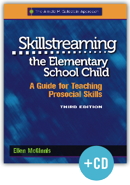
Skillstreaming the Elementary School Child (Book)-New Strategies and Perspectives for Teaching Prosocial Skills

Publication Date: 1997
Dr. Ellen McGinnis
Dr. Arnold P. Goldstein
 

1982.gif
Send to a Friend!

Add to Cart
$24.00
$21.60  On Sale!
Checkout

sku# 1982

Paperback, 350 pp

Related Titles:


Sub Products:

Printer Friendly


About the Author

Ellen McGinnis, Ph.D., has experience as an educator in public schools at both elementary and secondary levels. She has been an educational consultant to public and hospital schools and was Assistant Professor of Special Education at the University of Wisconsin-Eau Claire. For the past 6 years, Dr. McGinnis has served with the Des Moines Public Schools as principal of the education program at Orchard Place, a residential and day treatment center for children and adolescents with emotional and behavior disorders. She has written a number of books and numerous articles on identifying and treating youth with emotional and behavior disorders.

Arnold P. Goldstein, Ph.D. (1933-2002), was Professor of Psychology and Education at Syracuse University as well as Founder and Director of the Syracuse University Center for Research on Aggression. He authored over 60 books and more than 100 articles on aggression, prosocial skills training, and juvenile delinquency. He also served as Director of the New York State Task Force on Juvenile Gangs. Dr. Goldstein received many prestigious awards including the Career Achievement Award from the American Psychological Association's Commitee on Children, Youth, and Families; and the Senior Scientist Award from APA's School Psychology Division.

Summary

Skillstreaming addresses the social skill needs of students who display aggression, immaturity, withdrawal, or other problem behaviors. This newly revised book offers the most up-to-date information for implementing the Skillstreaming approach, which utilizes modeling, role playing, performance feedback, and transfer (homework). Students develop competence in dealing with interpersonal conflicts and learn to use self-control. The curriculum contains 60 skill lessons and includes five skill groups: Classroom Survival Skills, Friendship-Making Skills, Dealing with Feelings, Alternatives to Aggression, and Dealing with Stress.

Reviews

"An excellent guide for working with small groups and/or total classrooms on skills related to making the classroom a safe and secure place for optimum learning."
-- Jean V. Prosser, School Social Work Journal

"Each lesson follows the same steps and thoroughly describes problem-solving steps for each skill....In addition, the Skillstreaming program stresses practicing skills outside the teaching sessions, encouraging group leaders and other staff to provide prompts, reinforcement, and feedback to students in a variety of settings.
-- Jennifer B. Ganz, Intervention in School and Clinic

"The program is well-structured and easily adapted to student and teacher needs. Counselors and teachers are given a structured, but flexible plan for conducting a group of students in a positive learning experience."
-- Deborah R. Newman, Guidepost, American Counseling Association

Contents

Figures and Tables
Preface
Acknowledgments
Chapter 1 Introduction
Chapter 2 Skillstreaming: Past, Present, Future
Chapter 3 Skillstreaming and Safe Schools
Chapter 4 Skillstreaming Arrangements
Chapter 5 Skillstreaming Teaching Procedures
Chapter 6 A Sample Skillstreaming Session
Chapter 7 Skills for Elementary Students
Chapter 8 Refining Skill Use
Chapter 9 Managing Behavior Problems
Chapter 10 Teaching for Skill Generalization
Appendix A: Skillstreaming Research: An Annotated Bibliography
Appendix B: Skillstreaming Checklists and Grouping Chart
Appendix C: Supplementary Skillstreaming Components
Appendix D: Skillstreaming Materials for Other Instructional Levels
References
Name Index
Subject Index

List of Skills

Group I Classroom Survival Skills

  1. Listening
  2. Asking for Help
  3. Saying Thank You
  4. Bringing Materials to Class
  5. Following Instructions
  6. Completing Assignments
  7. Contributing to Discussions
  8. Offering Help to an Adult
  9. Asking a Question
  10. Ignoring Distractions
  11. Making Corrections
  12. Deciding on Something to Do
  13. Setting a Goal
    Group II Friendship-Making Skills
  14. Introducing Yourself
  15. Beginning a Conversation
  16. Ending a Conversation
  17. Joining In
  18. Playing a Game
  19. Asking a Favor
  20. Offering Help to a Classmate
  21. Giving a Compliment
  22. Accepting a Compliment
  23. Suggesting an Activity
  24. Sharing
  25. Apologizing
    Group III Skills for Dealing with Feelings
  26. Knowing Your Feelings
  27. Expressing Your Feelings
  28. Recognizing Another's Feelings
  29. Showing Understanding of Another's Feelings
  30. Expressing Concern for Another
  31. Dealing with Your Anger
  32. Dealing with Another's Anger
  33. Expressing Affection
  34. Dealing with Fear
  35. Rewarding Yourself
    Group IV Skill Alternatives to Aggression
  36. Using Self-Control
  37. Asking Permission
  38. Responding to Teasing
  39. Avoiding Trouble
  40. Staying Out of Fights
  41. Problem Solving
  42. Accepting Consequences
  43. Dealing with an Accusation
  44. Negotiating
    Group V Skills for Dealing with Stress
  45. Dealing with Boredom
  46. Deciding What Caused a Problem
  47. Making a Complaint
  48. Answering a Complaint
  49. Dealing with Losing
  50. Being a Good Sport
  51. Dealing with Being Left Out
  52. Dealing with Embarrassment
  53. Reacting to Failure
  54. Accepting No
  55. Saying No
  56. Relaxing
  57. Dealing with Group Pressure
  58. Dealing with Wanting Something That Isn't Yours
  59. Making a Decision
  60. Being Honest